Hoppin’ John – History of the Classic Good Luck Dish
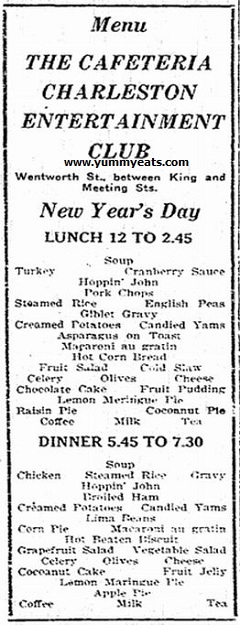
Hoppin’ John, a dish of black-eyed peas, cooked in some kind of pork fat, and rice, is a New Year’s tradition in many homes. It is likely that the dish is a descendent of a West African precursor, and was brought to America by African slaves. There is a dish called Akara that may be a distant relative. Similar rice and bean combinations are found throughout the Caribbean; in Spanish areas bollitos is a variant. In the United States, South Carolina seems to be the likely point of origin, though the dish is now popular throughout the south.
The origins of the name are more obscure. Many sources say it is a corruption of the French pois pigeons, meaning pigeon peas. Some point to the Caribbean Junkanoo which is a Carnaval or street parade, sometimes celebrated on New Years, which word itself was derived from the name John Canoe, a supposed name of an early African slave trader.
The association with good luck for the New Year involves several elements. The rice represents abundance. The black-eyed peas either stand for coins, or, because of their (somewhat) circular shape, signify the continuous cycle of the year. Pork represents looking to the future, because it is said that pigs cannot look backwards. Greens, often an accompaniment to Hoppin’ John, are the color of paper money. Sometimes a penny is placed in the pot, bringing good luck – or a trip to the emergency room – to the person that finds it. A safer variant may be to place a penny under each diner’s plate. Whether it is common for children to actually hop around the table before dinner is hard to ascertain, but there’s nothing to stop one from starting this tradition at their house.
A Hoppin’ John Recipe of the Old South
Here is a simple version from Civil War Cooking: The Confederacy, by Susan Dosier.
– – – – –
1 cup dried black-eyed peas
10 cups water, divided
3 bacon slices
1 small onion, chopped
1 green bell pepper, chopped
1 cup uncooked long-grain rice
1 1/2 tsp. salt
Garnishes: green onion pieces, tomato wedges
– – – – –
Soak peas overnight in water enough to cover by 2 inches. Drain peas and discard water. Bring peas to a boil in 7 cups of water over medium-high heat in a Dutch oven. Reduce heat and simmer 1 1/2 hours or until peas are tender. Cook bacon in a large skillet 5 until crisp; remove and drain on paper towels, reserving the drippings in the skillet. Crumble the bacon. Saute onion and bell pepper in the bacon drippings over medium heat until tender, about 5 minutes. Add the vegetable mixture, 3 cups of water, rice, and salt to the peas. Cook covered, over medium heat, for 20 minutes, or until rice is tender. Remove from heat, and let stand 10 minutes before serving. Sprinkle with the crumbled bacon. Garnish, if desired.
Yum, yum!


- Farmer’s Almanac Garden Guide : Peaches Recipe Contest - March 11, 2022
- Mooney Farms : Bella Sun Luci Annual Recipe Contest - March 8, 2022
- Weird Food Inventions and Strange Concoctions : Potato Chip Sandwich - February 24, 2022